
SPAD camera enabling high-speed, low-light imaging
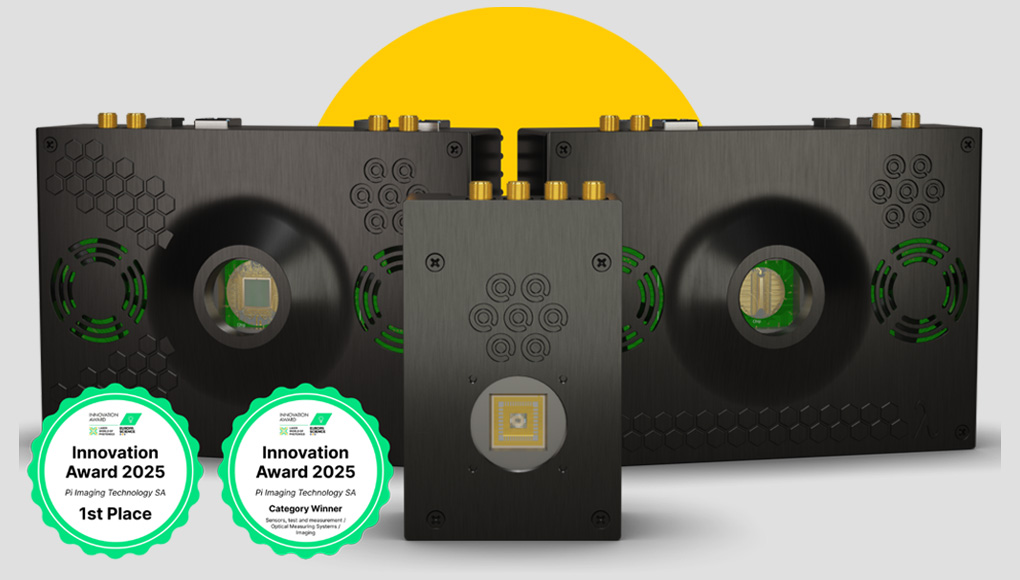
Before presenting his paper entitled ‘3 million frames-per-second SPAD RGB system for low-light high-speed imaging’ at Photonics West on 21 January at 6:00pm-8:00pm PST in the Poster Hall (Moscone West, Level 2), our head of IC design, Augusto Carimatto, sat down with Electro Optics for an interview.
Image sensors have been in the spotlight for few decades now, always pursuing best-quality images. The image quality relies on the combination of several factors, such as resolution, photo detector sensitivity, read-out noise and dynamic range.
For very long time, CMOS image sensors have been the undisputed option to choose. Nevertheless, emerging technologies can make this change; in our company, Pi Imaging Technology, we design image sensors based on SPAD photo detectors.
SPADs are photodiodes working in Geiger mode that have high Photon Detection Probability (PDP) with zero read-out noise; thus, making its Signal to Noise Ratio (SNR) higher than CMOS-based image sensors, resulting in higher quality for low light conditions. In addition, SPADs are well known for their highly accurate time resolution, making them invaluable for applications where the time of arrival of the photons carries fundamental information.
FLIM microscopy has become one of the most prominent applications for SPADs due to the characteristics of SPADs that fit this application. For FLIM microscopy, both light sensitivity and time information are extremely important in order to generate a high-quality image; two properties that SPADs excel at.
Decades of dedication to Engineering and Research allow us to fully enable the potential of the technology through innovative design techniques and new ideas rendered in major patents. The sensor comprises a 1 million pixel array with a time-gating module capable of 17-ps step window. It has been already implemented by microscope companies.
SPADs haven’t reached their maximum potential and they will be fundamental in the next developments in low-light cameras, high-speed imaging and space applications.
In my opinion, one of the biggest challenges in SPAD image sensors is the size of the array and the read-out capabilities. This challenge can be a high-way to a big opportunity for companies that are already in the business and know how to tackle them properly.
In general, as an engineer with a very strong scientific background, proud moments are those where I feel that have advanced the state of the art.
My contributions span from Digital Processing (Processors, memory, languages, algorithms) to Circuit Design of Image sensors and read-out systems.
In this line, the proudest moment of my career was the successful design and test of a SPAD image sensor that combined the characteristics of SPADs with a multilayer neural network for image recognition. I had to come up with multiple new ideas to make this work, as there were many technical challenges, moreover back in 2017 where there was little to no information about implementation.
The sensor is capable of processing 3 million images per second, making it one of a kind. It was published in Photonics West during the pandemic and unfortunately it had very little traction. I’m not sure if it was due to the pandemic itself or because it was too early for the AI explosion. Nonetheless, I’m very proud that I advanced the state of the art, and hopefully a student used the paper as a building block to further improve the state of the art.
Learn, prepare yourself, don’t be afraid of making mistakes and the most important, don’t look an already-existent solution to a problem before thinking how you would solve it by yourself. That, to me, is actually the definition of engineering.
Augusto Carimatto will present his paper ‘3 million frames-per-second SPAD RGB system for low-light high-speed imaging’ on 21 January, 6:00pm-8:00pm PST in the Poster Hall (Moscone West, Level 2).
Contact:
Pi Imaging Technology – a ZEISS company
www.PiImaging.com
info@piimaging.com
+41765733314