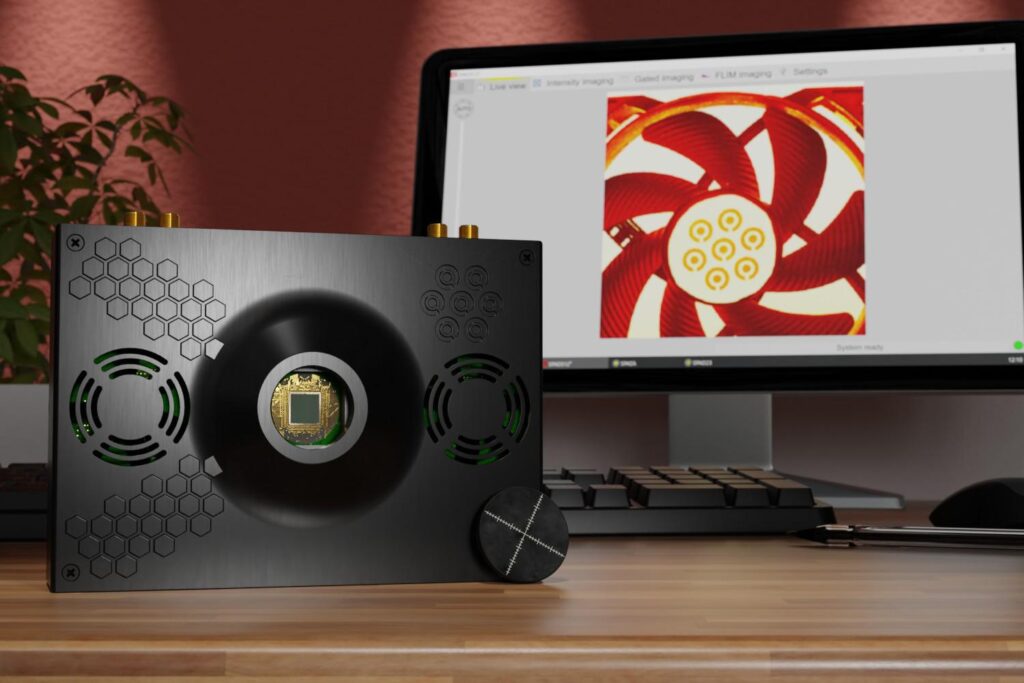
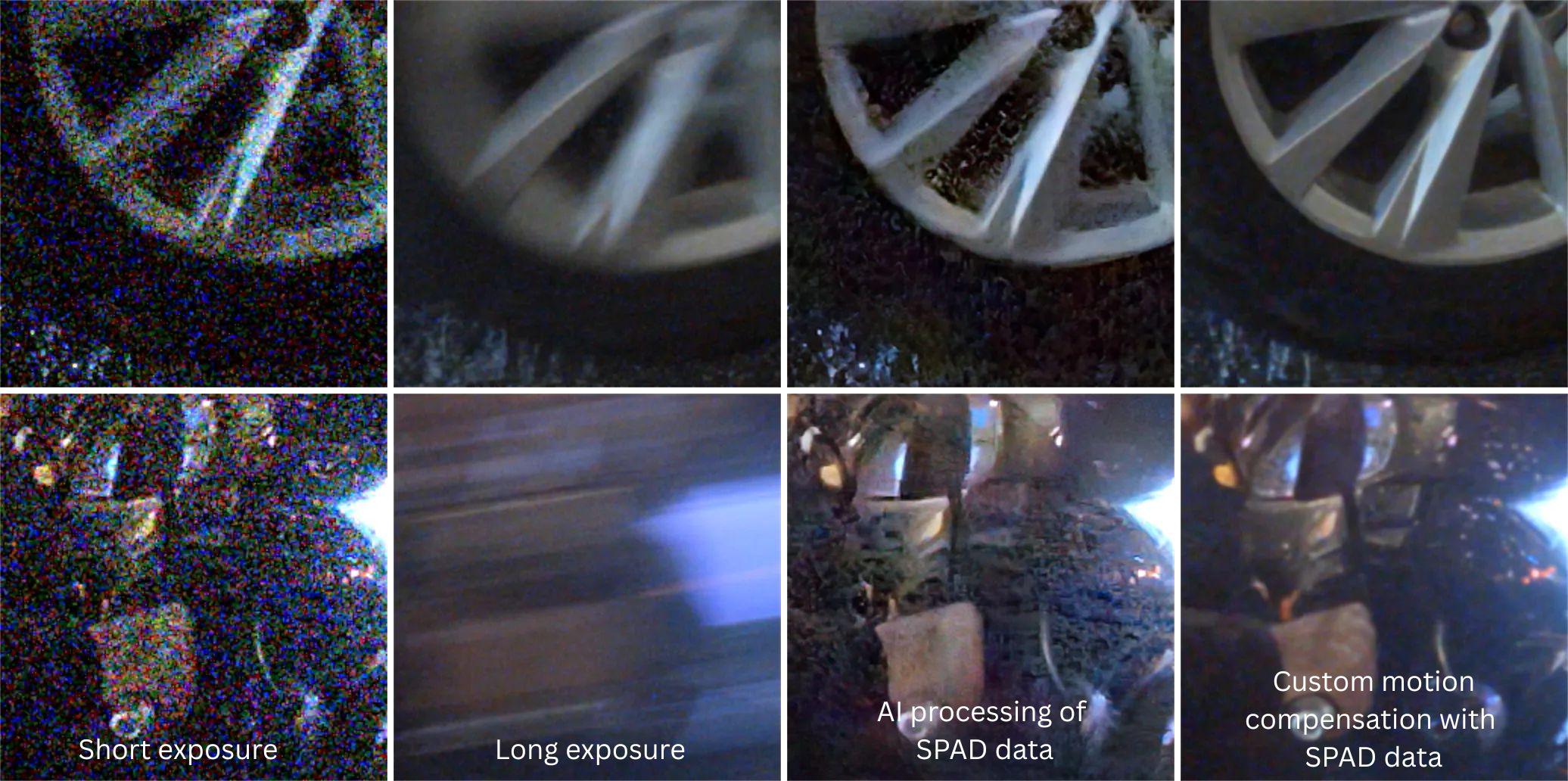
Because SPAD Alpha operates without readout noise, it can maintain image quality even when exposure times are drastically reduced. Users can therefore shorten exposure times to freeze motion and then use motion compensation processing to create a high signal-to-noise ratio image. In practical terms, SPAD Alpha enables imaging of fast-moving phenomena under extremely low-light conditions.
What are the technical details?
SPAD Alpha incorporates a highly flexible digital acquisition architecture that allows the user to trade temporal resolution, dynamic range, and data throughput depending on the application. The sensor supports 1-bit, 4-bit, 6-bit, 8-bit and up to 12-bit imaging modes. In 1-bit mode, each pixel records whether a photon was detected during an exposure window, enabling acquisition speeds up to 57,000 frames per second. Higher bit-depth modes accumulate multiple photon detection events per pixel, extending dynamic range and enabling quantitative imaging while maintaining the benefits of photon-counting operation. Continuous acquisition is supported at up to 920 fps in 6-bit mode and 230 fps in 8-bit mode, while time-gated operation enables bit depths up to 12 bits for advanced scientific measurements. This specific mode of operation enables motion compensation at low bit depth and recreation of a high-speed video without the tradeoff between image blur and noise. We specifically target motion compensation of up to 1000 fps, particularly suitable for demanding applications in low light (down to 50 mlux).
A key enabling technology is the camera’s programmable time-gating capability. The sensor can generate optical exposure windows as short as 6 ns with a timing shift resolution of only 17 ps between successive acquisitions. This makes it possible to separate photons based on their arrival time, enabling high dynamic range (HDR) imaging (up to 140 dB).
The innovation is further enhanced through compatibility with physics-based image processing technology. Rather than relying on conventional frame-based image reconstruction, we process the high-speed photon data stream generated by SPAD Alpha using Ubicept’s motion-aware photon fusion algorithms designed specifically for low-light dynamic scenes.
What are the target markets?
Machine vision systems are increasingly expected to inspect faster, operate with lower illumination levels, and deliver reliable results in uncontrolled environments. These requirements often lead to higher lighting costs, increased system complexity, and reduced throughput. SPAD Alpha addresses these challenges by enabling high-speed operation without requiring proportional increases in illumination power, allowing manufacturers to increase production throughput while reducing the power budget of their vision systems.
The technology is particularly relevant for inspection of rapidly moving objects, robotics, logistics automation, intelligent transportation systems, and autonomous platforms operating in low-light conditions. Because image quality is fundamentally limited only by photon shot noise rather than sensor readout noise, machine vision algorithms can work with cleaner and more reliable data, improving object detection, classification, tracking, and measurement performance.
Beyond conventional 2D imaging, the platform enables advanced sensing modalities such as depth extraction, object separation, and time-resolved inspection. These capabilities support the development of next-generation machine vision systems that combine perception, measurement, and analysis within a single imaging platform.
What is the unique selling point?
The first imaging platform to combine photon counting, ultra-high-speed acquisition, and motion-aware processing, delivering sharp, low-noise images in photon-starved environments.
Reach out to us and check out SPAD Alpha at Single Photon Workshop 2026